
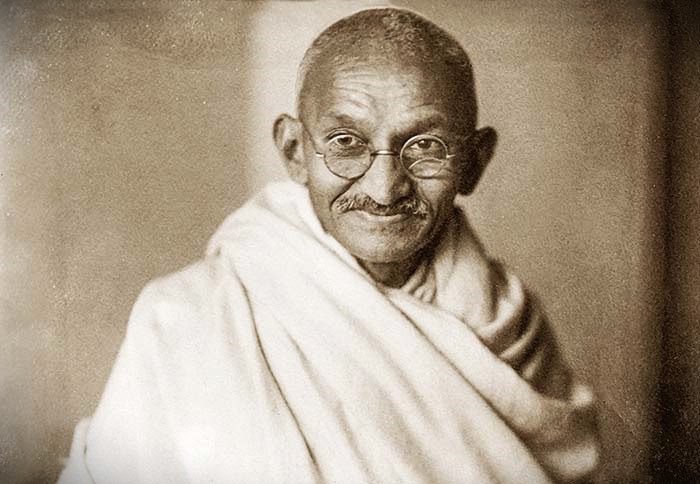
Gandhi was India’s ‘Father of the Nation’ who opposed Zionism in ‘Arab’ Palestine
By Omar Ahmed | Middle East Monitor
The ongoing genocidal war by the settler-colonial state of Israel against the Palestinians in Gaza has recaptured global attention and rejuvenated the Palestinian national liberation struggle. Nevertheless, the issue remains highly divisive, with one side advocating for a free Palestine and the other, smaller but significant, ideologically opposed to it, namely Zionists and their supporters.
In the realm of social media, the latter have found a prominent supportive voice among Indian Hindu nationalists. Their rabid anti-Muslim sentiments place them voluntarily at the forefront of the online propaganda and information war against the Palestinians.

However, this hasn’t always been the case, given India’s anti-colonial, independence leader Mahatma Gandhi’s position on Palestine. As such, there has also been renewed interest in the “Father of the Nation” and his opposition to the formation of a Jewish state in Palestine.
Mohandas Karamchand Gandhi was born into a devout Hindu family on 2 October, 1869, in Porbandar, a coastal town in present-day Gujarat, India. After completing his education in law in London, he embarked on a legal career in South Africa, where he would later become a leading figure in the struggle against racial discrimination there.
Returning to his homeland in 1915, Gandhi emerged as an important figure in the Indian independence movement against British colonial rule. He was also a vocal proponent of religious pluralism in India. However, revisiting his life in contemporary times has not been without controversies, such as his views on caste, race and women’s rights.
Gandhi’s opposition to Zionism wasn’t an isolated viewpoint, but part of his broader critique of imperialism and colonialism.
His philosophy of Satyagraha, which became associated with nonviolent resistance, transcended national borders and emphasised the interconnectedness of struggles against oppression worldwide.
He was also familiar with the emphasis placed on justice and standing up against oppression in Islam, once saying, with reference to the martyred grandson of Prophet Muhammad (peace be upon him), that: “If I had 72 companions like Hussain, I would have freed India in 24 hours, from the British,” and that “I learnt from Hussain how to achieve victory whilst being oppressed.”
For Gandhi, the creation of a Jewish state in Palestine would be inherently unjust and not even justified religiously. As acknowledged by the Jewish Virtual Library, an essay written by Gandhi in 1938 “about the Arab-Jew question in Palestine and the persecution of the Jews in Germany,” states:
“The cry for the national home for the Jews does not make much appeal to me. The sanction for it is sought in the Bible and the tenacity with which the Jews have hankered after return to Palestine. Why should they not, like other peoples of the earth, make that country their home where they are born and where they earn their livelihood?
Palestine belongs to the Arabs in the same sense that England belongs to the English or France to the French. It is wrong and inhuman to impose the Jews on the Arabs. What is going on in Palestine today cannot be justified by any moral code of conduct.
“The mandates have no sanction but that of the last war [World War One]. Surely it would be a crime against humanity to reduce the proud Arabs so that Palestine can be restored to the Jews partly or wholly as their national home.”
As a famous proponent of non-violent struggle, Gandhi even expressed his empathy with the Palestinian struggle:
“I am not defending the Arab excesses. I wish they had chosen the way of non-violence in resisting what they, rightly, regarded as an unwarrantable encroachment upon their country. But according to the accepted canons of right and wrong nothing can be said against the Arab resistance in the face of overwhelming odds.”
Officially endorsing the unviable two-state solution, New Delhi has maintained full diplomatic relations with Tel Aviv since 1992, and under Prime Minister Narendra Modi’s leadership, the ruling Bharatiya Janata Party (BJP) has strengthened trade and defence ties with the occupation state. The BJP also draws inspiration from Israel, viewing it as a model of a “religious-nationalist state,” offering an alternative vision to India’s founding secular and multi-religious principles.
It is interesting to note that India supported Palestinian nationalists during its own struggle for independence from British rule. In 1947, India proposed a plan for the creation of an independent federal state of Palestine, with constitutional safeguards for the Jewish minority. India’s concerns about the establishment of what was perceived as a settler state in the British Mandate for Palestine contributed to its vote against the UN resolution recommending the creation of Jewish and Arab states in a partitioned Palestine.
On 30 January, 1948, Gandhi was assassinated by Nathuram Godse, a Hindu nationalist and a member of the right-wing Rashtriya Swayamsevak Sangh (RSS), due to his perceived favouring and appeasement of Muslims over the interests of the Hindu majority. In today’s Hindu nationalist ruled-India, one can see a further erosion of Gandhian values, both domestically with rising anti-Muslim discrimination and violence, as well as in foreign policy through the strengthening of relations with the last remaining colonial outpost in the Middle East, the apartheid state of Israel.
Source-Credit: Middle East Monitor
Latest
“The Zionists indeed learnt well from the Nazis. So well that it seems that their morally repugnant treatment of the Palestinians, and their attempts to destroy Palestinian society within Israel and the occupied territories, reveals them as basically Nazis with beards and black hats.”
― Norman Finkelstein


Saya setuju dengan semua ide yang Anda sajikan dalam posting Anda. Itu sangat meyakinkan dan pasti akan berhasil. Namun, postingnya terlalu singkat untuk pemula. Bisakah Anda memperpanjangnya sedikit mulai waktu berikutnya? Terima kasih atas postingnya.
Anda bisa pasti melihat keterampilan Anda di dalam karya yang Anda tulis. Sektor berharap ada lebih banyak lagi penulis penuh semangat seperti Anda yang tidak takut menyatakan apa yang mereka yakini. Senantiasa ikuti hati Anda.
Bagian yang mengesankan, saya baru saja memberikannya kepada seorang rekan yang sedang melakukan sedikit sekali evaluasi tentang ini. Dan dia sebenarnya membeli saya sarapan sebagai hasil dari saya menemukannya untuknya.. senyum. Jadi biar saya ulangi: Terima kasih untuk traktiran! Akan tetapi ya terima kasih telah meluangkan waktu untuk membahas ini, saya sangat merasa kuat tentang hal ini dan suka mempelajari lebih banyak tentang topik ini. Jika bisa dilakukan, seiring Anda menjadi lebih ahli, apakah Anda berkenan memperbarui weblog Anda dengan tambahan detail? Ini sangat membantu bagi saya. Jempol besar untuk publikasi weblog ini!
Seseorang pada dasarnya membantu membuat artikel yang sangat baik, saya akan katakan. Ini adalah pertama kali saya mengunjungi halaman web Anda dan sejauh ini? Saya terkejut dengan riset yang Anda lakukan untuk membuat publikasi khusus ini luar biasa. Pekerjaan yang luar biasa!
Sangat menarik informasi!Sempurna persis seperti yang saya cari! “Menjadi kaya adalah memiliki uang, menjadi sejahtera adalah memiliki waktu.” oleh Margaret Bonnano.
Hmm apakah ada orang lain yang mengalami masalah dengan foto di blog ini yang tidak mau dimuat? Saya mencoba menentukan apakah ini masalah di sisi saya atau blognya. Tanggapan apa pun akan sangat dihargai.